Performance Analysis of Surrogates for the Non-Linear Heat Equation in Cryobot Applications
Abstract
Consider a moon, like Enceladus, which is mainly covered by a thing layer of ice. Underneath this ice, there is an underwater ocean. It is interesting to collect information about these underwater ocean for science reasons, to find new resources or maybe even extraterrestrial life.
To explore these underwater ocean a Cryobot can be used. This robot melts its way through the ice to then explore the ocean, underneath the ice. By melting its way through the ice, a fluid layer is generated at the cryobot, coming from the melted ice.
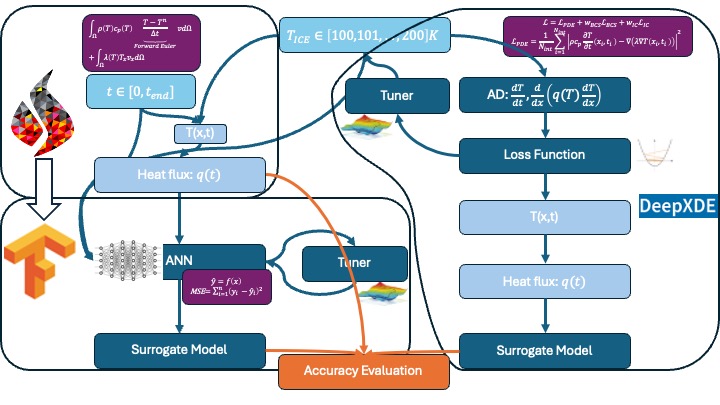
In this project, the heat exchange at the ice-water interface will be analyzed. For this, a forward numerical model was implemented with Finite Elements in the open-source software FEniCSx. Then, transient data for different boundary conditions was generated to train an Artificial Neural Network. As a next step, a Physics-Informed Neural Network was trained to predict the temperature directly, without any data. This temperature could then be used to predict the heat flux, based on the temperature gradient, with automatic differentiation.
Finally, the performance of both models was analyzed, in terms of accuracy, training and evaluation time and generalization capabilities.
The Model
The non-linear heat equation reads:
\[\begin{align*} \rho(T)c_p(T) \frac{\partial T}{\partial t} = \frac{\partial}{\partial x}\left(\lambda(T) \frac{\partial T}{\partial x} \right) \quad \text{on } \Omega = [0\text{m},2\text{m}] \\ T(x=0,t) = T(x,t=0) = T_\text{ICE} \in [100\text{K}, 200\text{K}] \\ T(x=2,t) = T_\text{MELTING} = 273.15\text{K} \end{align*}\]
The material parameter are taken from the paper Access to glacial and subglacial environments in the Solar System by melting probe technology
The Surrogate Modeling Workflow
The Code and Results
Find the code in the GitLab repository https://git.rwth-aachen.de/JanHab/icemelting with the documentation